
What Is an MVP? How to Know If Your Product Is Truly Viable
When transforming an idea into a product, understanding whether it is truly ‘viable’ is actually the most critical test.
 AI-generated image
In the modern product development period, the term "Minimum Viable Product" (MVP) has become a cornerstone of lean methodologies. It represents a fundamental shift from traditional, long-cycle development to an iterative, user-centric approach.
An MVP isn't just a product with fewer features; it's a strategic tool designed to test a core hypothesis about a market need with minimal effort. Done right, it helps teams validate ideas before committing major resources and can mean the difference between a successful launch and expensive failure.
We delve into what an MVP truly entails and how to assess its viability, ensuring our product has the best chance to thrive in this article.
In the modern business world, we can find plenty of examples of brilliant ideas that fail to materialize, often due to misjudging market needs or over-investing in features that no one wants. Research from CB Insights in 2021 highlights that "no market need" is one of the leading causes of startup failure, often accounting for over a third of all failures. This high failure rate shows the critical importance of validating assumptions early.
In the 2000s, the concept of the MVP emerged from the Lean Startup movement, popularized by entrepreneur and author Eric Ries, building on earlier work by Steve Blank. It's a response to the traditional "waterfall" product development model, which involves building products in isolation over long periods. So, they didn't meet user expectations. By focusing on the MVP, companies can gather "validated information" about customer preferences, adapt their strategies, and pivot as needed. This significantly reduces development risk and increases the likelihood of success. This methodology has become vital for startups and established enterprises that are seeking to innovate efficiently.
Let's Define the "Minimum" and "Viable"
The "Minimum" in MVP doesn't mean a worthless or incomplete product; rather, it states the smallest possible set of features required to solve a core problem for startups at the beginning of the road. It's about purifying the product from all non-essential elements to focus only on the value proposition. The "Viable" aspect refers to being functional enough to deliver that core value and attract initial users, enabling feedback collection.
 Minimum Viable infographic
For example, Dropbox's initial MVP was a simple explainer video demonstrating its file-syncing capabilities, long before the full product was built. This video validated significant market interest and collected too many sign-ups, proving viability without extensive development. The goal is not perfection, but learning about the product.
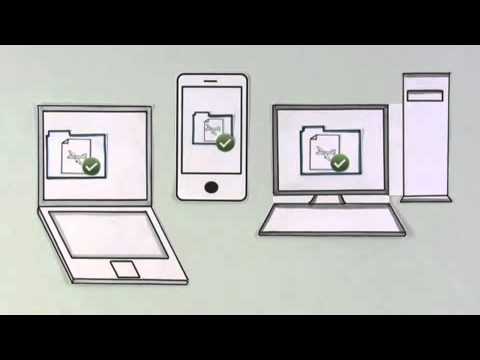 Original Dropbox Video explaining what Dropbox is
The Loop: Build-Measure-Learn!
At the heart of the MVP philosophy is the iterative Build-Measure-Learn feedback loop. After building an MVP, the next step is to release it, collect real data (Measure) and then analyze it to generate actionable insights (Learn).
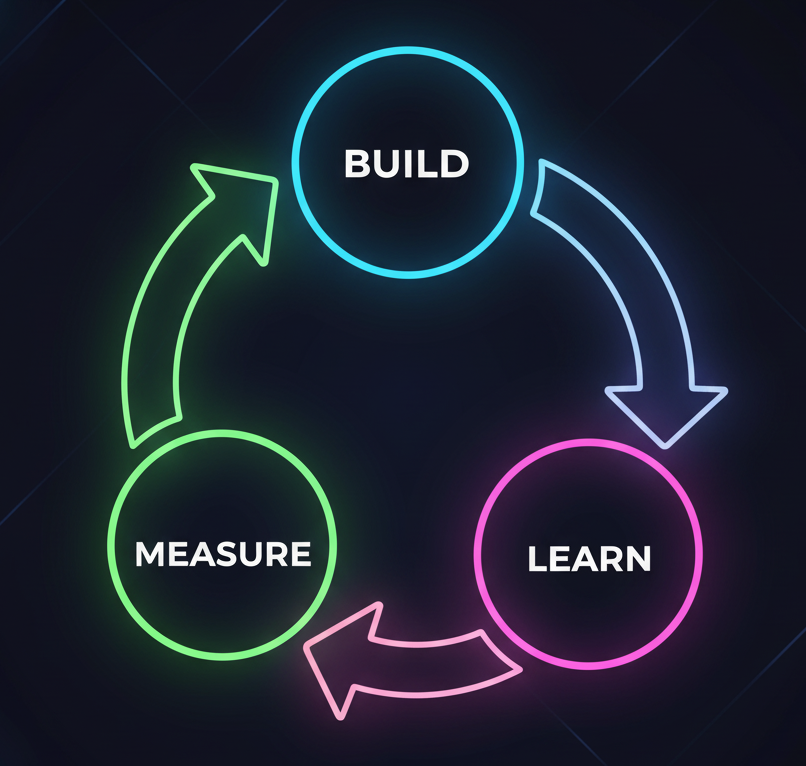 Build-Measure-Learn Loop
These insights inform what to Build next. The goal may be to enhance existing features, add new features, or even change the direction of the product. This process ensures that product development is driven by real user behavior and validated assumptions, not just hypothesis.
For example, Instagram started as "Burbn," a check-in app with multiple features. Then, they measured the user behavior and learned that photo-sharing was its most popular function. So, this data led them to focus only on that feature.
Focusing on a Single, Core Problem
A truly viable MVP goes a long way in solving a critical problem for its target audience in an extraordinary way. The desire to add multiple features (or feature creep) to appeal to a wider audience often undermines the core value and complicates the initial UX (User Experience). An MVP that focuses on a single pain point can deliver a clear and compelling solution that resonates strongly in the early stages.
 AI-generated image
For example, Airbnb's initial offering wasn't a global hospitality platform. It was a simple way for its founders to rent out air mattresses in their San Francisco apartment during a fully booked conference. This solution was successful in addressing a pressing and acute need for affordable accommodation at a time when hotels were scarce.
In Summary
The journey from an idea to a successful product is challenging, but the MVP approach provides a clear roadmap for overcoming these challenges. MVP is not simply a smaller version of a product, it is a learning tool. It encourages teams to develop minimally and focus only on core functionality that addresses a single, critical problem. This lean structure is followed by rigorous measurement of user behavior and continuous learning through feedback, creating an iterative cycle that continually refines the product's direction.
 AI-generated image
By embracing the MVP mindset, businesses can strongly reduce the risk of building something nobody wants, conserve valuable resources, and accelerate their path to market success. The key to recognizing whether a product is really viable lies not in its completeness, but in its ability to solve a real problem for real users, uncover valuable feedback, and adapt based on that learning. The most successful products often start small, prove their worth, and grow iteratively, guided by genuine user needs.