
What Happens When You Let People Think Without Limits?
How Blue Sky Thinking Drives Innovation, Creativity, and Strategic Growth
 AI-generated Image
The human mind is a limitless landscape, but it is often constrained by conventions, fears, or established paradigms. Throughout history, progress has consistently emerged from individuals and groups who dared to push these boundaries and create an environment in which ideas could flourish unimpeded. From sparking revolutionary innovations to redefining social norms, allowing people to think without limits unleashes a powerful force that reshapes our world and ourselves [Maslow, 1943]
In today's fast-paced and hyper-competitive world, businesses face a constant demand for innovation. While incremental improvements can be invaluable, they are often not enough to ensure a long-term relationship or create disruptive market advantages. It is at this stage that the Blue Sky Thinking Strategy emerges as an important methodology. At its core, blue-sky thinking is an unconstrained idea generation process that encourages participants to think without limitations, initially ignoring practical constraints, and explore radical, unconventional solutions to problems. It's about looking to the horizon and imagining possibilities that don't yet exist, rather than focusing only on what's immediately achievable. This strategic approach is vital for organizations that aim not only to adapt to change but also to shape the future and discover truly breakthrough opportunities proactively.
Navigating the VUCA World
The modern business world is characterized by unprecedented volatility, uncertainty, complexity, and ambiguity [VUCA]. Technologies evolve rapidly, consumer behaviors change unexpectedly, and new competitors can emerge from any industry to disrupt established industries. In this environment, organizations that adhere to traditional problem-solving methods that often focus on optimization within existing frameworks are at risk of becoming obsolete. Blue sky thinking is a powerful antidote to this inertia. It encourages a divergent phase of thought before convergent selection, challenging the tendency to self-censor ideas based on perceived feasibility or cost [McKinsey & Company, 2018].
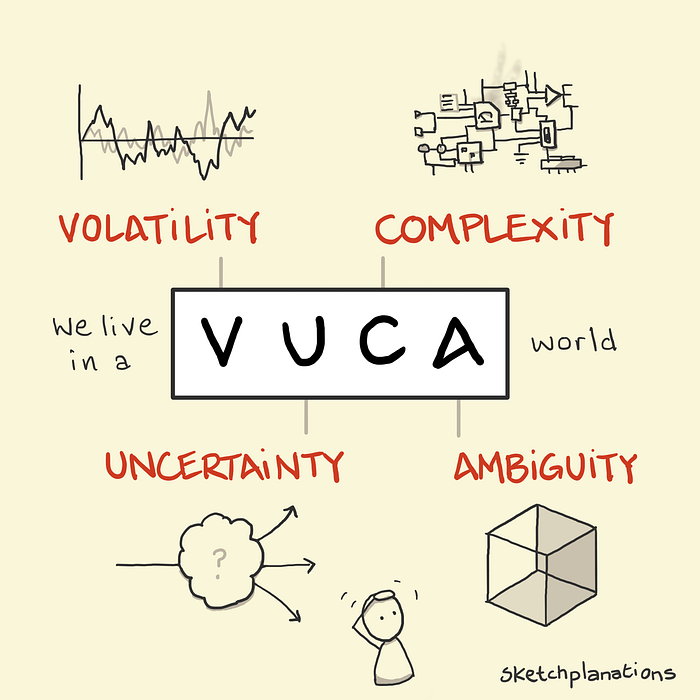 Image Credit: Sketchplanations
By creating a space for truly new concepts, companies can move beyond iterative improvements to develop breakthrough innovations that redefine markets and create entirely new value propositions.
Encouraging Unlimited Creativity
Blue sky thinking deliberately eliminates the 'rules' and 'limitations' often associated with problem solving at the initial ideation stage. This deliberate lack of restriction allows individuals and teams to explore a much wider range of possibilities, often leading to ideas that would otherwise be rejected too soon. The emphasis is on quantity and novelty of ideas rather than immediate viability or profitability [IxDF].
 AI-generated Image
For example, "How can we make our product 10% cheaper?" Instead of asking, the blue-sky approach is, "How can our product solve a problem so profound that the cost is negligible, or how can we deliver the service without any physical product?" he might ask. This divergent thinking process has been shown to produce more innovative solutions than purely convergent approaches that prioritize feasibility from the start.
Promoting Breakthrough Innovation
While incremental innovation focuses on improving existing products, services, or processes, blue sky thinking is a catalyst for breakthrough or radical innovation. It encourages the pursuit of "flight" ideas, which are ambitious, visionary projects that, if successful, can deliver exponential rather than linear growth [Google X (now X), 2023].
 AI-generated Image
By challenging conventional wisdom and designing entirely new paradigms, organizations can develop products or services that not only meet unmet needs but also create new needs. This type of thinking is critical to disrupting markets and providing a competitive advantage that is difficult for competitors to quickly imitate.
For example, the concept of driverless vehicles or widespread drone delivery emerged as highly speculative "blue sky" ideas before evolving into serious development projects [Wired, 2014].
Developing a Culture of Innovation
Implementing the blue-sky thinking strategy isn't just about a single brainstorming session; it's about embedding a mindset into an organization's culture. When employees are regularly encouraged to think big, challenge assumptions, and try bold ideas, an environment of psychological safety and creative courage is created. This cultural shift encourages continuous learning, adaptation, and resilience. Organizations that embrace blue sky thinking tend to be more agile, better equipped to handle disruptions, and more attractive to top talent looking for stimulating work environments. It shows that the company values new perspectives and is willing to invest in exploring unconventional paths, which strengthens its long-term innovative capacity [Great Place to Work, 2025].
 AI-generated Image
Google X (now X Development LLC)
Known as the "moon trip factory," Google was founded to invent and implement "radical new technologies to improve the world." X explicitly seeks "big problems, radical solutions, and breakthrough technologies" [X Development LLC Official Website, 2024]. Their process involves identifying major global challenges and creating solutions without concern for feasibility or immediate commercial viability. Projects like Waymo (autonomous vehicles), Wing (drone delivery), and Project Loon (internet balloons) have emerged from this limitless approach, often starting with ideas that seem almost impossible. The philosophy is to aim for 10x improvement, not 10% [Astro Teller: Google X Head on Moonshots, 2013].
 Image Credits: X
Dyson’s Bagless Vacuum Cleaner
James Dyson's journey to create the bagless vacuum cleaner is another perfect example of blue sky thinking. Frustrated by his vacuum cleaner's decreasing suction power, Dyson questioned the basic assumption that vacuum cleaners needed bags. This led him to explore industrial cyclone technology and make it suitable for home use. It built 5,127 prototypes over five years, enduring countless failures and rejections from established manufacturers who saw no need to replace a profitable existing model [Dyson Official Website, Sir James Dyson Biography]. The search for a radical and unproven solution to conventional wisdom ultimately led to the emergence of a whole new product category, disrupting the global vacuum cleaner market and establishing Dyson as an innovation leader.
 AI-generated image
Blue sky thinking isn't just a creative exercise; It is a strategic imperative for organizations aiming to thrive in an unpredictable future.
So, how can your organization put blue sky thinking into action?
- Embrace Unlimited Idea Generation
Create special spaces and times where all ideas, no matter how outlandish, are welcomed and explored without immediate judgment. Encourage a "yes, and…" mentality.
- Separate Divergence from Convergence
Understand that the blue sky phase (idea generation) should be different from the next phase of evaluating and selecting ideas. Early judgment hinders innovation [NNGroup, The Diverge-and-Converge Technique for UX Workshops, 2024].
 AI-Generated Image
- Improve Psychological Safety
Create a safe corporate culture where employees can share their unconventional thoughts and experiment without fear of failure or ridicule. This is crucial to unlocking true creative potential.
- Balance Vision with Pragmatism
Although blue-sky thinking starts with no boundaries, it eventually needs to connect with a strategic roadmap. The most powerful innovations emerge by combining radical vision with disciplined execution [MIT Sloan Management Review, 2016]. By strategically integrating blue sky thinking into their innovation processes, organizations can unlock breakthrough solutions, cultivate a vibrant culture of creativity, and gain a lasting competitive advantage.
Want to be the first to see new posts? Subscribe to get updates straight to your inbox.