
The CEO of the Numbers and the People in the Profit-Loss Ledger
Values lost in the shadow of financial logic and the intrigue of the CEO.
 Image Credit: Mr Burns
Sometimes it seems logical to put a financier in the CEO's seat. It appears to be a strategic move aimed at maximizing profits, maintaining control over cash flow, and ensuring investor confidence. But behind every decision where financial logic prevails, there are real people. Employees and partners often get lost in the shadow of this logic.
The CEO of numbers dominates the balance sheet and profit-loss statements. It cuts "unnecessary" expenses, freezes unprofitable projects, and maintains the financial health of the company. Investors smile at a strong quarterly report. In times of crisis, this perspective might indeed keep the company alive. But behind these spreadsheets and quarterly targets, employees experience real consequences-sometimes suddenly, like Emma.
Emma's Dilemma
Emma was called into the meeting room. The CEO of the numbers, without lifting his eyes from the charts, said quietly:
"Unfortunately, your position has been terminated."
Emma was in shock. "Why?" she asked,
But the answer was not clear. She heard vague statements like "As per company strategy" or "Not a good fit."
 Emma's Dilemma: Navigating sudden termination in the shadow of financial decisions (AI-generated image)
Nothing concrete.
A few weeks later, Emma heard that some positions at the company were being quietly filled, and new team members were being hired. Rumors had spread that some employees were forced to resign under "special agreements". The spreadsheets on the CEO's table seemed to explain everything, but Emma had only one question in her mind:
"Was I the problem, or was it just for the profit?"
The dismissal was made clear, but there was no honesty about the reason; This silent cowardice created a risky environment for both the employee and the company.
Emma's experience is not unique. Large corporations, such as Amazon, have faced waves of layoffs, affecting tens of thousands of employees simultaneously.
The King of Layoffs: Amazon
Amazon has experienced a wave of major corporate layoffs in recent years, and its frequent layoffs are making headlines.
According to Reuters, the company planned to cut around 30,000 corporate roles in early November as part of a major cost-cutting effort to simplify operations following over-hiring during the Covid-19 pandemic. While this may seem like a small fraction of Amazon's total workforce of 1.55 million, it represents 10% of the company's approximately 350,000 corporate employees. This was the largest layoff since the 27,000 layoffs implemented between the end of 2022 and the beginning of 2023. This move follows a Fortune report indicating that the company plans to lay off up to 15% of its human resources workforce, with more layoffs expected across multiple departments.
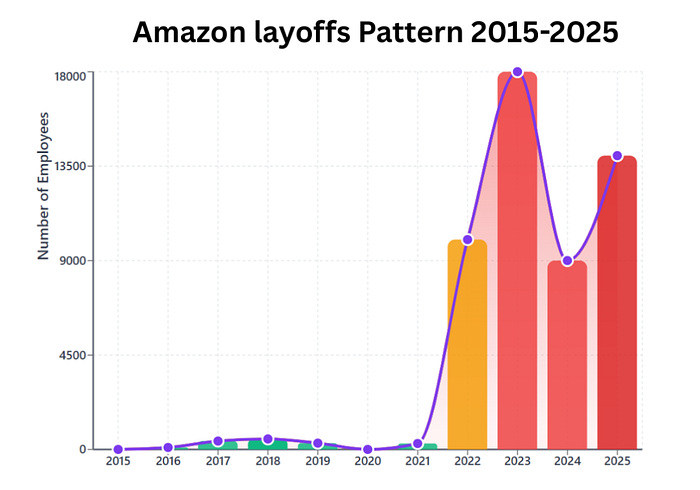 Image Credit: Coruzant
Amazon has been gradually reducing staff across various business units, including devices, communications, and podcasting, over the past two years. Previous reports from Bloomberg indicated that approximately 110 positions were eliminated in Amazon's Wondery podcast division. The company will lay off several hundred employees from its Amazon Web Services (AWS) cloud division in July 2025, while approximately 100 positions were cut from its devices and services division in May.
While Amazon has had many more layoffs, we have tried to include the most recent ones.
Such large layoffs don't just impact those leaving — they also have measurable effects on those who remain. Research IWH Halle quantifies this impact.
In the research conducted by IWH Halle, a 12% decrease in the performance of the remaining employees was observed after the unfair dismissal announcement, and a 12% decrease in "gross working time" was reported.
Let's do a little calculation: If an employee's eight-hour workday equals 100% performance, a 12% drop means a 1 hour of lost productivity per person, per day.
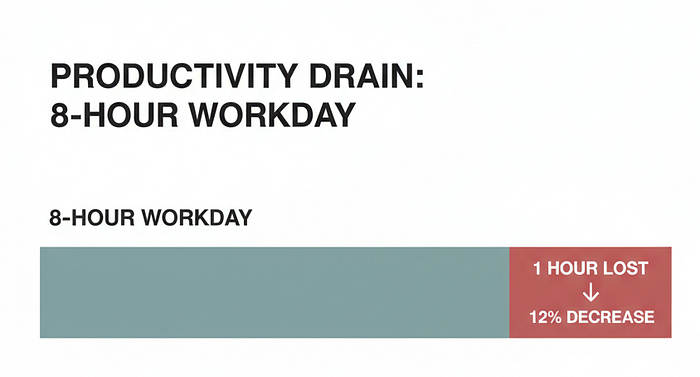
While spreadsheets quantify losses, the human impact is far more complex.
The productivity drop and stress caused by layoffs are symptoms of a broader issue: constant interruptions and misaligned priorities in modern workplaces. This is where Calm Tech offers a solution.
How Can Calm Tech Be a Solution?
The biggest problem with the chaos in modern business life is that no one has time to truly think. Constantly interrupted focus, shifting priorities, and endless notifications silently exhaust employees.
This is where Calm Tech comes in.
It does not slow companies down.
It gives pace meaning.
It gives employees the courage to say "stop" and teaches the company that less can actually be better. By reducing meeting load, weakening the culture of urgency, and clarifying processes, Calm Tech helps reduce burnout and improve output. In short, Calm Tech offers a solution that puts people at the center of the work, increasing productivity through clarity, not panic.
 Calm Tech principles are minimizing interruptions and fostering focused work (AI-generated image)
Calm Tech aims to establish systems that inform and support employees, not constantly alarm them. Notifications, meetings, and internal communications are kept to a minimum; a pace that fosters deep work is established instead of unnecessary interruptions.
Constant talking at the individual level is seen as a sign of inefficiency. So why aren't endless meetings, notifications, and corporate noise questioned in the same way at the company level? Is silence only a virtue expected from employees?
This approach doesn't embrace an "always-on" culture. It promotes a system that supports openness of written communication and process transparency. As companies simplify complexity and refine information flow, employee satisfaction increases and mental strain decreases. Calm Tech re-humanizes work by recognizing that people are not just laborers; they also possess attention, focus, and emotional energy.
Companies that embrace Calm Tech implement systems and processes that minimize noise, support focus, and foster asynchronous work. Some well-known examples include Basecamp, Doist and GitLab.
- Basecamp has been operating with asynchronous communication and low meeting density for years; employees are not expected to be constantly online or productive.
- Doist has a completely distributed structure; it doesn't have a rhythm that demands constant, rapid responses to messages throughout the day.
- Despite being a massive organization, GitLab manages the entire process with detailed documentation, eliminating the need for constant interruptions.
 Working in a calm, focused work environment (AI-generated image)
The common thread among these companies isn't a slowdown in pace, but a noise reduction. By calming the environment, they create space for employees to think clearly.
Companies are not just about numbers. Success is shaped by people's effort and commitment, as well as profit and growth. Financial logic alone is not sustainable; Ignoring the human factor leads to greater losses in the long run. Seeing the values lost in the shadow of the numbers is perhaps the most difficult but most necessary calculation, because in the shadow of cowardice and silent greed for profit, the value of humanity should not be forgotten.
Want to be the first to see new posts? Subscribe to get updates straight to your inbox.